 Christmas is an annual festival commemorating the birth of Jesus Christ, observed primarily on December 25 as a religious and cultural celebration among billions of people around the world.
Although Christmas is celebrated all over the world, each country treats the festival differently with different customs and traditions. Here are a few from the UK.
Do you still do some of these?
Xmas
Why do we call it Xmas, instead of Christmas? The “X” comes from the Greek letter Chi, which is the first letter of the Greek word Christós (Greek: Χριστός), which became Christ in English. The suffix -mas is from the Latin-derived Old English word for Mass.
Boxing Day
Boxing Day is a public holiday the day directly after Christmas. And, although there’s a lot of different theories about the origins of Boxing Day, it is generally thought that the day was created as a holiday for the tradesmen to receive a ‘boxing,’ or gift, the day after Christmas. Nowadays, many Brits use their day off on Boxing Day to travel and visit their relatives.
Putting a silver coin in the Christmas Pudding
Christmas pudding is a type of fruit pudding that is served in the UK during Christmas dinner. The pudding was first eaten in the UK back in the 14th century and is normally made with raisins, currants, prunes, wines and spices. An interesting Christmas tradition in the UK involves placing a silver coin in the pudding that is said to bring luck to the person who finds it.
This tradition is thought to have originated in the court of King Edward II where a bean or dried pea would be placed inside the pudding and whoever got a slice with it in would be crowned King or Queen for the day.
Eating turkey on Christmas Day
Although turkeys are not native to the British Isles (they were first brought to Britain in the 16th Century), people in the UK began to eat turkey during Christmas dinner as farmers would be in need of their cattle for milk and would often be saving their chickens to lay eggs. Before this, British people would often eat geese, boar and even peacocks.
A huge amount of people are now opting for a vegetarian or vegan way of life, so less turkey is now consumed.
Giving presents on the 25th of December
While giving presents is a normal part of Christmas celebrations around the world, very few countries actually give and receive gifts on the 25th December. In many other European countries, it is custom to give gifts on the 24th and in Spanish speaking countries it is often custom to give presents after Christmas. The United Kingdom is one of the few countries where gifts are opened on Christmas Day itself.
Pulling Christmas crackers
If you’ve ever been to a Christmas party, lunch or dinner in the UK, you’ve probably seen a Christmas cracker. These festive table decorations are pulled apart to reveal a small gift, a party hat and a riddle or a joke. When they are pulled they make a ‘snap’ or ‘cracking’ sound which is what gave them their name.
Crackers were first created in the mid 19th century by a sweet maker called Tom Smith who tried selling sweets around Christmas time with a small motto or riddle included in the packaging. Later, he decided to add the ‘crackle’ element after seeing logs crackle on a fire.
Eating mince pies
Eating mince pies (small pastries filled with currants and dried fruit combined with herbs and spices) is a popular tradition in the UK around Christmas time. Although the filling of the pie is described as ‘mincemeat,’ mince pies do not contain meat. Mince pies are such an important part of Christmas in the UK that on Christmas Eve children often leave them as a treat for Father Christmas along with a carrot for his reindeer.
Going to the pantomime
A Christmas pantomime, which is sometimes known as a ‘panto,’ is a musical comedy show that British families will often go and see over the Christmas period. ‘Pantos’ often borrow story lines from well-known fairy tales or fables and mix them with pop cultural references and drag and are the perfect activity to do over the British winter.
Watching the Queen’s Speech from this year it will be the King’s speech
Ever since 1932, when King George V gave his first radio broadcast on the BBC’s Empire Service, the Queen (or King)’s speech has been an important part of British Christmas culture. Nowadays, the Queen’s Christmas message has watched on television by millions of British people every year. For the first time this year King Charles III will address the nation.
Filling a shoebox with charitable donations
The tradition of filling shoeboxes with charitable donations began in 1990 when a man named Dave Cooke saw the suffering of Romanian orphans on the television and decided to help. He organised people in his hometown in Wales to donate money to the orphanages, meanwhile, children filled shoeboxes with toys and gifts for the children. The success of the initiative received a lot of media attention and filling shoeboxes with gifts for the less fortunate has become a regular occurrence at Christmas time throughout the UK.
Hanging out stockings on Christmas Eve
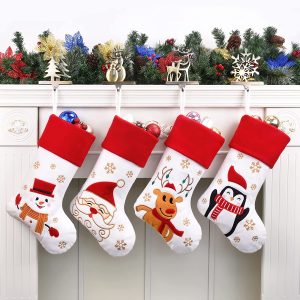 On Christmas Eve, children around the UK hang stockings (a type of large sock) on their fireplaces (or wherever is convenient) so that Saint Nicholas (otherwise known as Santa Claus or Father Christmas) can fill their stockings with presents, fruit, candies or coins. In the Western tradition, it is believed that if children are badly behaved their stockings will be filled with a single lump of coal instead of presents.
Nowadays obviously adults fill the stockings with little bits and bobs known as stocking fillers.
And not only that we also get Christmas Eve boxes, filled with gifts, PJ’s and activities to do on this evening.
Christmas Jumpers
What would Christmas be now without the ever allusive Xmas jumper? Well I have to admit, I have a few in different colours to match the event! Why not show off yours on the Facebook groups?

Leave a Reply