Why do Scouts wear Neckerchiefs
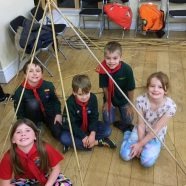
A Scout Scarf or otherwise known as a Necker is made from triangular piece of cloth. The long edge is rolled towards the point, leaving a portion unrolled. The Scarf is then secured at the two ends either woggle or tied using a Friendship knot. So, Why do Scouts wear Scarfs?

Photograph by Sam Longhurt Photography
The origin of the Scouting Scarf/ neckerchief seems to be in Robert Baden-Powell’s participation in the Second Matabele War in 1896; where he worked with Frederick Russell Burnham, an American-born scout employed by the British Army.
BP copied Frederick’s practical style of dress, including “a grey-coloured handkerchief, loosely tied around the neck to prevent sunburn”. When Baden-Powell launched the Scout Movement with the book Scouting for Boys in 1908, he prescribed a neckerchief or scarf as part of the Scout uniform, which he stated was “very like the uniform worn by my men when I commanded the South African Constabulary”. He continued; “Every Troop has its own scarf colour, since the honour of your Troop is bound up in the scarf, you must be very careful to keep it tidy and clean.”

Initially, Scout neckerchiefs were tied with a variety of knots, but the use of a “woggle” or slide, originated in the United States in the early 1920s and quickly spread around the Scouting world.
Each Scout group would have a neckerchief of different design and colours. In most countries each Scout Troop uses its own colour Scarf. The colours are usually the “Troop Colours” which may have a historical significance to the troop or to the local community.
Baden-Powell designed the Neckerchief to protect the neck from sunburn, but even more important than this intended function was B-P’s eye as an artist. Around the world, a full-sized Neckerchief is the most striking aspect of the Scout Uniform! The size of a Traditional Boy Scout Neckerchief is a square 32″ X 32,” and it is worn over the collar.
 Photography by Sam Longhurst Photography
This came across the pond in America…
The Neckerchief as a reminder of the Scout Oath and Law (from uscouts.org) My first Scoutmaster taught the importance of the Scout Oath and Law using the Neckerchief. He would hold the open neckerchief in his hands and remind the young scouts of what the last item of clothing they put on when they were getting dressed for the meeting was, his neckerchief.
The Scoutmaster then said that it was no coincidence that the neckerchief had 3 sides, just like the three parts of the Scout oath. He would run a side through his fingers and say “On my honour, I’ll do my best. To do my duty to God” The first and longest side is to remind you of your long-standing duty to God. This whole side is hidden from view, just as your faith is deep inside you. But without that faith, there is no strength for the rest.
Holding on to the neckerchief by the point he would run the next side through his fingers and say, “To help other people at all times….” This shorter side is to remind you of your duty to help others. Remember it is some of this duty that shows to others, just like part of this side of your neckerchief shows. So do your duty to others well so that people might see the good work you do in the name of Scouting.
The last side also shows. He would say “To keep myself physically strong, mentally awake and morally straight.” This last side is your duty to yourself. This shows to others as well. They will know that by seeing your uniform, you are a young man who is physically fit. Has a strong moral foundation and who is not apt to fall into the temptations of drugs and alcohol. He would then say that this was a means by which we could remember the Scout Oath, every time we got dressed in uniform.
Of course we call it the scout promise now, and we have different versions for inclusivity for differnt cultures, but maybe you can share with your young person so that they may use it to help them remember the promise they made at investure.
Well there you go, the reason why us Scouts all wear Scarfs.
Adapted from Big man in the woods
 We hope you can attend the short meeting. Join us to find out how we have managed the group over the past year, and have your say how we run the next year.
 There are a few things that you need to be aware of for returning to face to face meetings.
 It’s the 15th century and China is facing invasion from the Huns, a nomadic tribe keen to conquer the land. In an effort to gather defence, one man from every family is called to arms. But for the patriarch of the Fa family – a former warrior of great fame and respect – there are issues preventing him from fulfilling his duties. In old age, he cannot walk properly, and is certain to perish as soon as he steps into battle. That’s when his brave daughter, Mulan – tired of being mocked for being too ambitious and too tomboyish – decides to go on a secret mission to prove her worth in a society she feels is yet to acknowledge it. One dark and stormy night, she prays to her family’s ancestors for protection before fleeing into the heart of the conflict, dressed in her farther’s armour and disguised as a man. What follows is a classic Disney story of bravery, honour and a quest for love and truth – with a difference. Released at a time where the only other princesses on screen were mostly seen swanning around in big ball gowns and fainting
 ‘The whole universe depends on everything fitting together just right. If one piece busts, even the smallest piece, the entire universe will get busted.’ Set in the fictional landscape of the Bath Tub (often compared to areas of New Orleans after Hurricane Katrina), this is the tale of Hushpuppy, a heroic six year old who – faced with a changing climate that threatens to flood what remains of her childhood home – decides to fight back. Along the the way, she must sail the seas, battle ancient creatures unleashed from the melting ice caps, and find her feet in an increasingly hostile world. It’s a fable that’s hard to describe, but don’t let the quirky appearance fool you. Beneath the whimsey is a film of lasting depth: a celebration of friendship forged across generations, the power of imagination and the importance of never giving up. It’s a tough watch in places, with moderate swearing and several harsh truth bombs that reveal the deep divide between the rich and the poor. But watch it with young people aged eight and above and it’s sure to become a firm favourite.
  It’s 2001 in Malawi and the Kamkwamba family, like many others in the region, are struggling to make ends meet. Despite the burdensome financial costs, parents Trywell and Agnes try to keep on top of their children’s education. But when 13 year old William is forced to leave school after they fall behind on his payments, he becomes determined to help not only his family but the whole community, who are all doing their best to deal with an escalating famine
 This film’s beautiful hand-drawn animations breathe life into the most magical of Celtic myths, capturing the story of the selkies – mythical creatures capable of theriantrophy: the art of changing from animal (in this case, seal) to human form. The story follows Ben, a 10 year old boy who lives with his father, Conor, sister, Saoirse, and sheepdog, Cu, in a lighthouse near the Irish shore.
 Though this ’80s classic features several big scares and swears that will render it unsuitable for some young people, it remains an absolute favourite at camps and sleepovers – and it’s not difficult to figure why.
  When we’re introduced to nine year old Icare, aka Courgette, he’s alone in his bedroom, surrounded by worn down crayons and spilled beer cans. Downstairs, his mother burps and yells at the TV. A ripped up family photo lies on the floor and an argument breaks out. After a terrible fight, Courgette finds himself sent to a children’s home where, in the words of one long-time resident, ‘Everybody’s the same: there’s no one left to love us’. What follows is a hilarious, heart wrenching insight into the care system, from the point of view of those within it. Blending wry dialogue with hartwarming stop-motion animation and a great soundtrack, it’s a unique and irresistible tale of resilience, hope and humour in the face of life’s bleakest scenarios; a testament to the power of the families we create for ourselves, geniously disguised as a harmless children’s film. Suitable for adults (who’ll be bowled over by its brilliance and tenderness) and young people (who will rightly miss some of the film’s underlying themes, but gain lots nonetheless): we can’t recommend it highly enough.
 In October 2012, 15 year old Malala Yousafzai was riding the bus when a member of the Taliban came on board,
 Michael Bond – author of the original author of the original Padding books (later a TV series) – grew up in Britain during the second world war, and watched as his parents opened their home to evacuees fleeing persecution.
  Filmed in an orphanage in the Kingdom of Eswatini (formerly Swaziland), Liyana tells the story of five children who call it home and the paths that led them there. With the support of their teachers, they’re encouraged to work together to turn past trauma into an original folk tale about a brave young girl who embarks on a perilous quest to save her twin brothers from danger. Weaving together sublime 3D animation and behind the scens footage, the film is part documentary, part interactive storybook – seamlessly blending fact and fiction to offer a rare perspective,